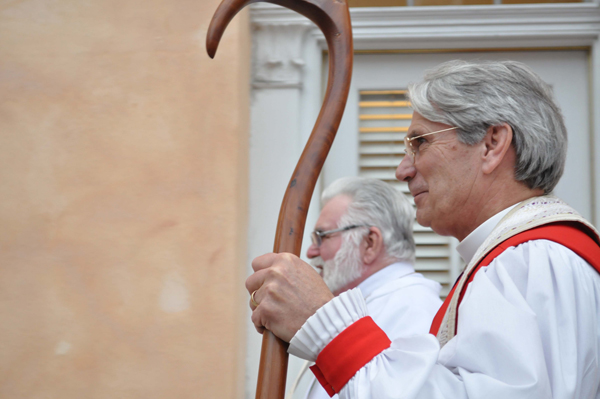
South Carolina Episcopal Bishop Mark Lawrence. RNS photo courtesy of Diocese of South Carolina.
This image available for Web and print publication. For questions, contact Sally Morrow.
(RNS) When disgruntled congregations have left hierarchical denominations such as the Episcopal Church, they’ve often lost property battles as civil courts ruled buildings and land are not theirs to keep.
But outcomes could be different this year, court watchers say, as high-profile cases involving dozens of Episcopal congregations in South Carolina and Texas wind their way through state courts. That prospect has observers watching for insights that could shape legal strategies in other states and denominations.
Both cases involve conservative dioceses that voted to leave the Episcopal Church over homosexuality, among other issues. In South Carolina, congregations representing about 22,000 people are suing the Episcopal Church for control of real estate worth some $500 million and rights to the diocese’s identity. In Texas, the national Episcopal Church is suing about 60 breakaway congregations in the Fort Worth area for properties estimated to be worth more than $100 million.
The Episcopal Church argues, as it has in past cases, that local properties are held in trust for the denomination and can’t go with parishioners who choose to disaffiliate. But recent court actions are giving breakaway groups hope that things might go differently this time.
In South Carolina, plaintiffs are encouraged by a 2009 ruling by the state Supreme Court that allowed All Saints Church of Pawley’s Island to retain property despite having left the Episcopal Church. If other breakaway churches have similar documents as All Saints did – deeds and contracts that show no intention to hold property in trust for the Episcopal Church – then they could win, according to Lloyd Lunceford, a Louisiana attorney and editor of “A Guide to Church Property Law.”
“When no trust exists at all, the local church wins,” Lunceford said. “The South Carolina Supreme Court, like many state supreme courts, has held that the mere presence of an assertion of a trust (existing) in a denominational constitution is insufficient to create a valid legal trust. There has to be more.”
In considering the breakaway churches’ appeal in the Fort Worth case, the Supreme Court of Texas is hearing its first church property case since 1909. The court is expected to clarify whether church property disputes in Texas will be decided by so-called “deference principles,” which prevailed in 1909 and tend to favor top hierarchical entities.
Another option is to apply “neutral principles,” which consider such factors as canon law, state law and agreements made among local churches, dioceses and other denominational entities.
Courts have increasingly used neutral principles, observers say, in part to avoid becoming ensnared in polity or theological debates. If the Texas high court uses that approach, then departing churches could win on the grounds that Texas law broadly allows for the revocation of trusts, according to Scott Brister, a former Supreme Court of Texas justice who’s now representing the Fort Worth defendants.
Revocable trusts, Brister said, include any that might be established by the Episcopal Church’s so-called Dennis Canon, which was added in 1979 and says parish properties are held in trust for the Episcopal Church.
“We’ve got defenses that say we never agreed to the Dennis Canon, but let’s say for the sake of argument that we did” agree to it, Brister said. “Under Texas law, you can revoke it,” he said, adding that the Diocese of Fort Worth did exactly that more than 20 years ago.
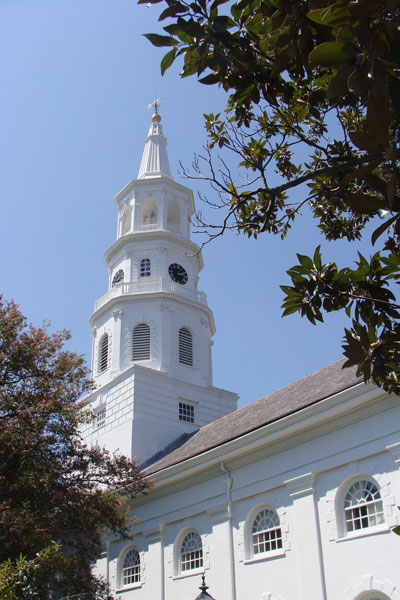
St. Michael’s, a church within the Diocese of South Carolina, is one of the most prominent Episcopal churches in Charleston, S.C. RNS photo by Kevin Eckstrom
This image available for Web and print publication. For questions, contact Sally Morrow.
The Episcopal Church, however, has a history of winning property cases, and expects to build on that success. Fort Worth Episcopal Bishop Rayford B. High Jr. argues the Dennis Canon is binding since local churches agreed to abide by it.
“They were given access to church titles and church properties because they promised to abide by the Episcopal Church” and its canons, High said. “Commitments were made. You can’t just decide a little later on, ‘I think I’ll change my mind.’”
In South Carolina, the case is no slam dunk for recently departed churches, according to Martin Nussbaum, a Colorado Springs lawyer who specializes in church property cases. He notes the Episcopal Church has prevailed in most of its property cases, in part because local churches have agreed to abide by the Episcopal Church’s constitution.
But, he adds, the South Carolina Supreme Court 2009 Pawley’s Island decision could help today’s plaintiffs win.
“It’s possible that the secessionists will have some success for some time, as long as they’re in the South Carolina courts,” said Nussbaum, an attorney with Rothgerber Johnson & Lyons. “If it goes over to (the U.S. Supreme Court), they’ll lose.”
To date, the U.S. Supreme Court has shown little interest in reviewing state decisions in church property cases. Brister expects that will not change, and state decisions will stand. The high court’s reticence to intervene might bode well for breakaway Anglicans in South Carolina, according to Robert Tuttle, professor of law and religion at George Washington University Law School.
“In South Carolina, where the South Carolina Supreme Court has ruled in favor of a separating congregation, (lower court justices) might be more sympathetic to the claim of the separating diocese of South Carolina” than judges in other states might be, Tuttle said.
Both the Texas and South Carolina cases are being watched closely, in part because of their size. Both involve dioceses and dozens of churches in large states, where jurisprudence can influence how judges in other states approach property cases, according to Brister.
The Texas decision “could influence other states, depending on what the circumstances of their state laws are,” Brister said.

22 Comments
What if Gay Kids had a Church that Loved Them?Article Directory
[...] All eyes on Texas, SC church property fights (RNS) When disgruntled congregations have left hierarchical denominations such as the Episcopal Church, they've often lost property battles as civil courts ruled buildings and land are not theirs to keep. But outcomes could be different this year … Read more on Religion News Service [...]
Janine
Christians are to settle their disputes within the church using church/canon law. The Bible gives a directive to Believers warning them to stay away from the secular courts settle disputes amongst one another,
All eyes on Texas, S.C. church property fights - Religion News Service | New Mexico's US Senators | Scoop.it
[...] (RNS) When disgruntled congregations have left hierarchical denominations, civil courts traditionally have said buildings and land are not theirs to keep. [...]
All eyes on Texas, SC church property fights - Religion News Service - Coastal Real Estate News | Coastal Real Estate News
[...] All eyes on Texas, SC church property fightsReligion News ServiceIn South Carolina, congregations representing about 22,000 people are suing the Episcopal Church for control of real estate worth some $500 million and rights to the diocese's identity. In Texas, the national Episcopal Church is suing about 60 … [...]
RevBill
The article has this sentence, “Courts have increasingly used neutral principles, observers say, in part to avoid becoming ensnared in polity or theological debates.” But there is nothing “neutral” when the courts define “the body of Christ” as excluding the sacred (theological), physical space/property for worship, teaching and mission. Just as water, bread and wine have spiritual meaning when set apart in worship, so does religious space. When our courts define away a denomination’s definition of the spiritual relationships among its congregations (polity), the same courts will be asked, in time, to define away other areas of church and congregational life. I predict that the US Supreme Court will support the Episcopal Church under the First Amendment and I pray they have the guts to appeal all the way if the state courts rule against them.
Who owns the church building?: The Episcopal Case | God is Sometimes Great
[...] When this happens, it leaves open a vital question: the question of who, exactly, has rights to the church property. Traditionally, the Episcopal Church has been able to win the rights to the property on the grounds that it owns the local properties and has rights to the Episcopal Church name. But two large cases, one in South Carolina and the other in Georgia, could conceivably go either way – and with them, five hundred million dollars in property. [...]
shorelineliz
this situation has been going on for decades in the Episcopal Church. So much so that already 1/3 or about 300 Bishops left within ECUSA to form another communion. I don’t know what happened with all their property but I think most just left and forfeited the buildings. It isn’t that hard for a congregation to start over. Just move all your money together. Start over. There are new buildings to build.
Tony
I think the property should go with whoever paid for it. If the Episcopal Church did not purchase the property they they have not rights to if. My experience has been the congregations purchases their own property so why should the Church get to keep it.
Janine
Generations of Episcopal Believers paid for those properties. People who didn’t espouse the sin that is now being preached from its pulpits. The LORD God will padlock the episcopal church which contains these false teachers residing within the new age episcopal social club(can’t call it a church when Jesus’ & the Bible are not at the center of its teachings).
Paul Y Stephens
“They were given access to church titles and church properties because they promised to abide by the Episcopal Church” and its canons, High said. “Commitments were made. You can’t just decide a little later on, ‘I think I’ll change my mind.’”
The Episcopal Church should listen to their own comments here. “You can’t just decide a little later on, I think I’ll change my mind.”
When these congregations were agreeing to the doctrine of the church, they had no idea the long established biblical doctrine would change. The church’s doctrine was based on the obedience to scripture. Now they have decided to ignore the teachings of scripture in favor of heretical teachings in direct opposition to established Cannon.
The church broke the agreements and trust with it’s parishioners not the other way around. When the leadership of the church turns it’s back on God’s word and precepts then they are the ones who need to be cast out. The local congregations who decide to continue in abiding with scripture are the true church and deserve it’s property.
Southern Baptist
The denomination has betrayed GOD and these right-minded local churches OWN the property!
I would burn the buildings before allowing these sexual deviants to take them!
Janine
GOD is purging the church, Those whose heart knows not the LORD will fall away by the wayside. That which is for GOD will grow stronger and be made purer. Persecution and turmoil will bring forth the true adherents to The LORD GOD and these will be cleansed, purer and stronger in faith.
Philip J. DiNovo
I am interested!
All Eyes on Texas, S.C. Church Property Fights
[...] Read More [...]
REAL Christian
The leadership of this “church” had betrayed the Bible thus have zero right to the property!
Like “Southern Baptist” said, I would burn the building before turning it over to mentally ill people (homosexuals) and their leader named Satan!
RevBill
Look out ‘REAL Christian,” you are inviting the civil courts to get involved. Actually the criminal courts would deal with an arsonist who burns down a building. Don’t allow your harsh words to be defined as “hate speech.” Keep your arguments filled with biblical and loving language, else even OTHER Christians may find them betraying what Jesus taught in the Sermon on the Mount.
Southern Baptist
No, REAL CHRISTIANS handle the evil gay agenda the way Jesus handled the “money changers” at the temple! We don’t bow to Satan…we fight him.
RevBill
Or maybe REAL CHRISTIANS handle sin as Jesus did with the woman caught in adultery.
Southern Baptist
Jesus told her (and other’s) to “go thy way and SIN NO MORE” and these gays refuse to give up the sin (lifestyle) thus there is no forgiveness! This so-called “church” had chosen to please these mentally-ill, sexual deviants over God thus these “churches” are DAMNED>
RevBill
But, Southern Baptist, it’s the crowd with stones in their hand that we need to consider. It’s too easy for us in the crowd; we are quick to identify sin. Who was Jesus telling the story for the benefit of? I believe it’s for those of us with stones in our hands to have ears to hear and listen.
Who owns the church building?: The Episcopal Case
[...] When this happens, it leaves open a vital question: the question of who, exactly, has rights to the church property. Traditionally, the Episcopal Church has been able to win the rights to the property on the grounds that it owns the local properties and has rights to the Episcopal Church name. But two large cases, one in South Carolina and the other in Georgia, could conceivably go either way – and with them, five hundred million dollars in property. [...]
faithforsc – All eyes on Texas, S.C. church property fights
[...] Show caption [...]