



VIENNA (RNS) Austria’s Muslim community is incensed over the government’s plans to amend the country’s century-old law on Islam.
The new bill, championed by Minister for Foreign Affairs and Integration Sebastian Kurz, forbids foreign funding of mosque construction or of imams working in the country and requires a unified German-language translation of the Quran.
The government argues the legislation, which Parliament will vote on this month, will help combat Islamic radicalism. Muslim groups and civic activists say it flouts the principle of equality.
“There is a general tone of mistrust toward Muslims,” said Carla Amina Baghajati, a prominent Muslim rights activist and spokeswoman for the country’s Islamic Religious Authority, referring to the bill. “The 1912 Islam law has set up a model of how state acknowledgment of a religious minority can help this minority better integrate. Muslims in Austria are proud of this law.”
The Islam law, or the Islamgesetz in German, was introduced by Austria’s last emperor, Franz Josef, in 1912 after the Austro-Hungarian Empire annexed Bosnia-Herzegovina. The law made Islam an official religion and guaranteed Muslims wide-ranging rights, including religious instruction in public schools.
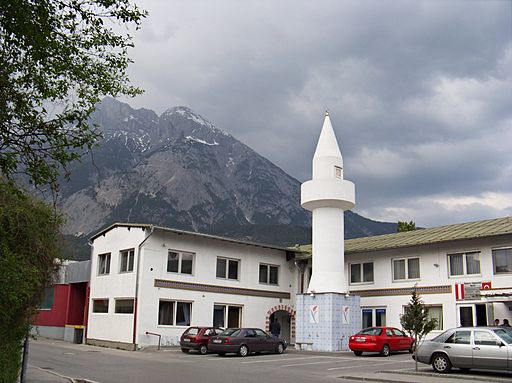
Eyüp Sultan mosque in Telfs, Austria.
Austria’s 8.4 million people include half a million Muslims, many of Turkish or Bosnian origin.
Only Belgium and parts of Spain offer Muslims the same legal protections, said Farid Hafez, a political scientist at Salzburg University.
“But in contrast to them, the institutionalization of Islam here is much more advanced,” Hafez said.
Even so, both the government and Muslim groups agree the original law must be updated to keep up with the times.
“The old text does not reflect the practical questions of our time such as chaplaincy in hospitals or at the military,” said Baghajati of the Islamic Religious Authority.
But she fears the legislation may put at risk a “long tradition of interreligious dialogue and cooperation” fostered by the 1912 law.
The bill has other controversial parts besides the proposed ban on foreign funding and the requirement of a unified Quran translation. It expands the definition of Islam to include the Alevi, a religion of Turkish origin that combines elements of Shiite Islam.
Kurz, the foreign affairs and integration minister, is adamant the changes are necessary.
“We want an Islam of Austrian coinage, an Islam that is independent of influence from abroad,” he told an Austrian broadcaster earlier this month.
Up to 50 Austrian citizens have joined jihadist groups in Iraq or Syria, according to Austrian magazine Das Biber, which has close links to the country’s Muslim community. In a highly publicized case earlier this year, two Austrian-born Muslim girls reportedly married Islamic State fighters in Syria.
But critics of the legislation abound.
Political analyst Thomas Hofer said many Austrian organizations, including political parties, are financed with overseas money, and the proposed legislation is a dubious attempt to show the Austrian public that the government is trying to do something against extremism.
Hofer said the bill plays into the hands of Austria’s right-leaning Freedom Party, which has seen an upsurge in support over the past decade and came in third at the general elections last year.
Two weeks ago, the Freedom Party staged a protest against the construction of a Muslim seminary in a Viennese suburb.
Johannes Huebner, an official in charge of the Freedom Party’s international relations, did not deny the party’s critical stance toward Islam.
“People are suspicious of Muslims, of their different customs, different holidays, different approach to family, to the role of women and the role of religion in politics.”
He acknowledged a ban on foreign funding would never fly with Austria’s Jewish or Christian community but added, “Given the present problems, it is adequate.”
YS/MG END KOROLYOV