




ORLANDO, Fla. (RNS) Christian ministers should establish relationships with law enforcement, seek ways to become moral authorities in their communities and listen.

Alex Medina, music producer and art director at Reach Records. Photo courtesy of TGC 2015
Those were the top recommendations from experts at a panel sponsored by The Gospel Coalition on Tuesday (April 14) titled “Seeking Justice and Mercy From Ferguson to New York.”
The popular ministry offered an alternative approach to that of evangelist Franklin Graham, who was widely criticized for his recent “Obey the police, or else” comments on Facebook. The comments followed the spate of police killings of unarmed black men.
In response to that Facebook post, 31 African-American, Hispanic and Asian-American leaders, many of them evangelicals, signed an open letter to Graham, saying he revealed a lack of empathy and understanding of the justice system.
At Tuesday’s panel, pastor and former public defender Ed Copeland; music producer Alex Medina; Sanford, Fla., Police Chief Cecil Smith; and U.S. Attorney Robert Lang offered tips to help ministers and other church leaders become “ministers of reconciliation.”
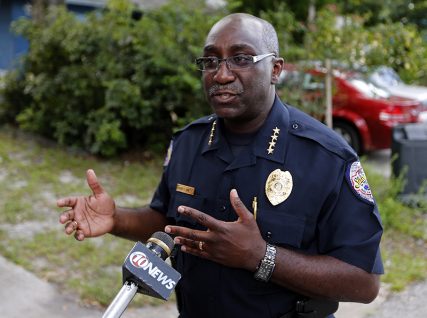
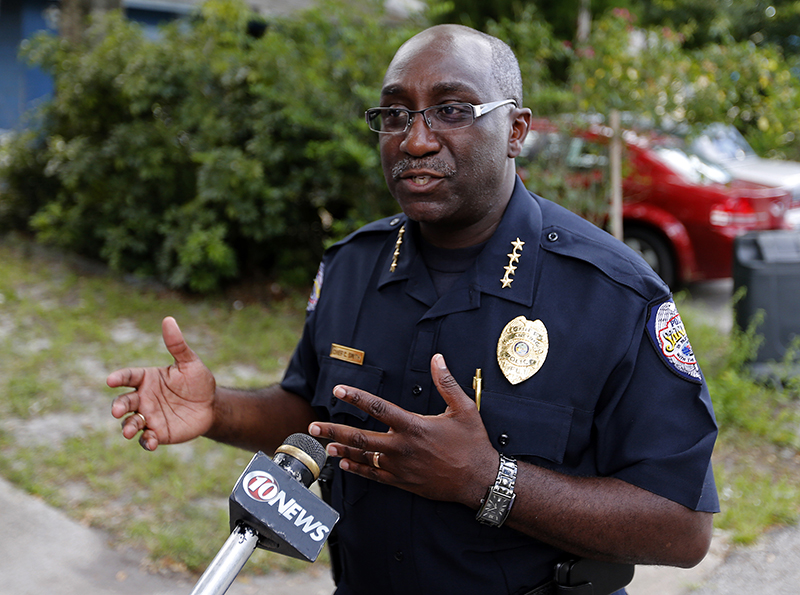
Sanford Police Department Chief Cecil Smith speaks with a reporter as he takes part in his “Walk and Talk” program in the town where George Zimmerman’s second-degree murder trial is being held in Sanford, Fla., on July 11, 2013. Photo courtesy of REUTERS/Joe Skipper
*Editors: This photo may only be republished with RNS-GOSPEL-FERGUSON, originally transmitted on April 15, 2015.
Panelists urged ministers to find out whether their communities use a focused deterrence policy, and if so, to get on board. The policy calls for community leaders to approach small groups of lawbreakers and warn them about the consequences of their behavior rather than arresting them outright.
“There’s a role in this policing where a community’s moral voice explains their goals and what actions they won’t tolerate,” Copeland explained. “Usually, this moral voice is one of two people: the criminal’s mother or their pastor.”
The policy can be effective if pastors are respected as moral authorities in their neighborhoods. But they can only be respected if they’re active in their community.
Medina pointed to a popular 1962 memoir, “The Cross and the Switchblade,” as an example of how a pastor’s presence can change lives. In that book, later made into a movie, Pastor David Wilkerson tried to be present in New York City gangster Nicky Cruz’s life. Wilkerson’s presence eventually caused Cruz to repent of his crimes and become a Christian.
Medina also recommended that Christians use social media to help create a presence in places where injustice is occurring. Not only can it be used to share information, it can be used to listen.
Finally, Christians need to remember to develop the discipline of listening. All the panelists recommended that pastors do all that they can to become more approachable by all community members, regardless of religious background.
What practical steps can ministers take toward getting involved?
“Ninety-nine percent of police departments have a guy who handles community relations,” said Smith, who urged pastors to find out what programs the police are trying to implement. He also recommended looking into whether the department has a chaplain program.
Lang mentioned that many U.S. attorneys’ offices have Project Safe Neighborhood coordinators who can provide ideas for pastors to get involved.
Bradford Davis, an African-American technical writer from New York, said he appreciated the advice.
“Hearing from a law enforcement officer, as well as an artist with his ear to the broader #blacklivesmatter movement like Alex Medina, enriched the conversation,” he said.
YS/MG END HUTTON