


Blacks say atheists were unseen civil rights heroes
Why is Martin Luther King, a Christian, remembered by so many for his contributions to the civil rights movement while A. Philip Randolph, an atheist, is honored by so few? That is a question many black nonbelievers are asking this Black History Month. By Kimberly Winston.


(RNS) Think of the civil rights movement and chances are the image that comes to mind is of the Rev. Martin Luther King Jr. leading the 1963 March on Washington.
But few people think of A. Philip Randolph, a labor organizer who originated the idea of the march and was at King’s side as he made his famous “I Have a Dream” speech.
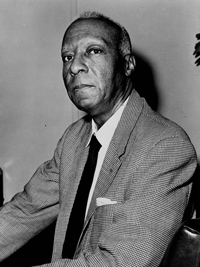
A. Philip Randolph was the co-leader with Martin Luther King of the 1963 March on Washington and was the founder of the Brotherhood of Sleeping Car Porters, the first predominantly black union.
Why is King, a Christian, remembered by so many and Randolph, an atheist, by so few? It’s a question many African-American nontheists — atheists, humanists and skeptics — are asking this Black History Month, with some scholars and activists calling for a re-examination of the contributions of nontheists of color to the civil rights movement and beyond.
“So often you hear about religious people involved in the civil rights movement, and as well you should, but there were also humanists,” said Norm R. Allen Jr. of the Institute for Science and Human Values, a humanist organization based in Tampa, Fla.
“No one is discussing how their beliefs impacted their activism or intellectualism. People forget we are a diverse community. We are not monolithic.”
Allen has promoted recognition for African-American nonbelievers since he founded the group African Americans for Humanism in 1989. This year, more than 15 local AAH chapters are expected to highlight Randolph and about a dozen others as part of their observance of a Day of Solidarity for Black Nonbelievers on Sunday (Feb. 26).
The hope, Allen said, is that highlighting the contributions of African-American humanists — and humanists in general — both in the civil rights movement and beyond will encourage acceptance of nonbelievers, a group that polls consistently rank as the least liked in the U.S.
“So often people look at atheists as if they have horns on their heads,” Allen said. “In order to correct that, it would be important to correct the historical record and show that African-American humanists have been involved in numerous instances in the civil rights movement and before.”
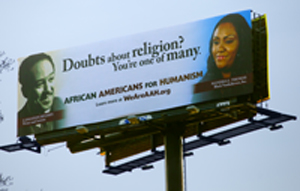
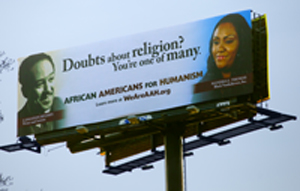
African Americans for Humanism have erected billboards in several cities featuring black icons, including Langston Hughes on this billboard in Atlanta, alongside African-American atheists.
AAH is also promoting black humanists in a billboard campaign in several cities, including New York, Dallas, Chicago and Durham, N.C. Each one pairs a local black nontheist with a black nonbeliever from the past. “Doubts about religion?” the billboard reads. “You’re one of many.”
A billboard in Los Angeles pairs Sikivu Hutchinson, a humanist activist based in Los Angeles, with Zora Neale Hurston, a folklorist of African-American culture who wrote of being an unbeliever in her childhood. Hutchinson, author of the forthcoming “Godless Americana: Race and Religious Rebels,” links blacks’ religiosity with social ills such as poverty, joblessness and inequality.
“To become politically visible as a constituency, it is critical for black nonbelievers to say we have this parallel position within the civil rights struggle,” she said.
A strain of unbelief runs across African-American history, said Anthony Pinn, a Rice University professor and author of a book about African-American humanists. He points to figures like Hubert Henry Harrison, an early 20th- century activist who equated religion with slavery, and W.E.B. DuBois, founder of the NAACP, who was often critical of black churches.
“Lorraine Hansberry, Richard Wright, Langston Hughes — they were all critical of belief in God,” Pinn said. “They provided a foundation for nontheistic participation in social struggle.”
But they are often ignored in the narrative of American history, sacrificed to the myth that the achievements of the civil rights movement were the accomplishments of religious — mainly Christian — people.
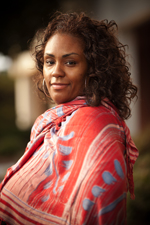
Mandisa Thomas of Atlanta is featured alongside Langston Hughes on a billboard in Atlanta that’s part of a campaign featuring icons of the civil rights movement who were not religious, sponsored by the group African Americans for Humanism.
Add in that black nonbelievers are a double minority — polls show African-Americans are among the most religious U.S. group — and it becomes even more difficult to discuss the atheism of heroes of black history.
“This is a country that loves the rhetoric of the belief in God,” Pinn said. “And think about how things currently stand. You can be socially ostracized and lose all sorts of connections by voicing one’s disbelief. If it raises these sorts of questions now, what were the consequences of doing it during the mid-20th century when everything about black life in the U.S. was in question?”
Juan Floyd-Thomas, a religious historian and professor at Vanderbilt University and author of a book on the origins of black humanism, agrees with Pinn, and called the traditional view of the civil rights movement as an inevitable extension of American Christianity “a mythology.”
Wright’s and Randolph’s critiques of organized religion, Floyd-Thomas said, “would not be too far out of step with the New Atheists” — best-selling atheist authors like Richard Dawkins and Christopher Hitchens. But he laments that most African-Americans and even many nontheists are unaware of this history.
“One of the things that can be gained from shining a bright light on the contributions of nontheists to the broad sweep of the civil rights movement would have to be integrity,” he said. “These people had a moral core and that’s something that is sorely needed, whether you are a theist or a nontheist.”