



(RNS) Growing up in Kuwait, Asif Balbale thought he wanted to become a chemical engineer. He never imagined enlisting in the U.S. Navy, much less becoming an imam.
Balbale got his engineering degree after immigrating to the U.S. at age 21. With jobs hard to come by, he tried to enlist in the Army, but didn't weigh enough. Instead, he met the Navy's minimum requirements.
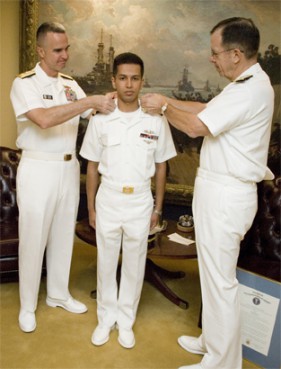
Then-Chief of Naval Operations Adm. Mike Mullen, right, and Rear Adm. Alan Baker, Deputy Chief of Navy Chaplains, left, commission Ensign Asif Balbale in 2007 into the Chaplain Corps as the third Muslim chaplain in the U.S. Navy.
He was sworn in as a U.S. citizen in 2005 while deployed aboard the USS Boxer. Intending to apply for an officer program, Balbale, 31, mistakenly emailed a recruiter for the chaplain corps.
“God, I think, had better plans for me,” Balbale said, looking back.
And so it is for a number of military chaplains who, by twists of fate or perhaps divine Providence, found their calling to become chaplains while on active duty.
Now assigned to Camp Pendleton in California, Balbale is among more than 800 chaplains in the Navy and one of only a handful of Muslim chaplains. More than 3,000 chaplains — the vast majority non-Catholic Christians — serve across all branches of the armed forces.
Balbale received his master's degree in spiritual theology from the Claremont School of Theology and was endorsed as an imam by the American Muslim Armed Forces Veterans Affairs Council. For the most part, the people to whom he ministers are not of his faith.
“My duty is to show care and concern, have a listening ear for them and seek ways to help” them according to their own faith, he said. Also important, he said, he gives Marines a better understanding of Islam.
Although many chaplains enter military service straight from seminary, Balbale is not alone in finding his religious calling while serving regular military duty.
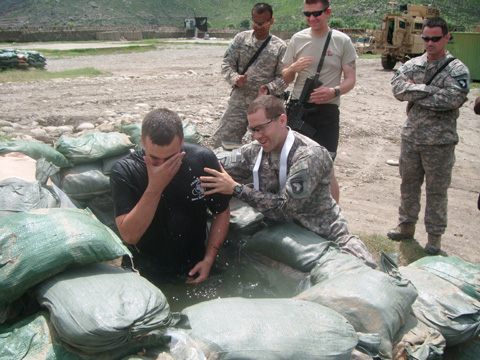
Joseph Odell was in high school when he received a mailing from the U.S. Military Academy at West Point. “It looked really cool,” the captain said. “Little did I know what I was getting myself into.”
Army Chaplain Capt. Joseph Odell baptizes a fellow soldier on the field in Afghanistan.
Although he grew up nominally Christian, it wasn't until he was 21 that he “became a Jesus follower.” Wherever his Army deployments took him, he would attend Sunday services and assist the chaplain. He soon realized that the “gifts God had given me for leadership would allow me to lead spiritually.”
In 2005, he enrolled at Southern Baptist Theological Seminary, returning to Army duty in 2009. Stationed at Fort Campbell in Kentucky, Odell, 38, said more than half of the soldiers he sees don't share his religion.
“I'm just meeting them where they are and trying to help them get where they need to be,” he said.
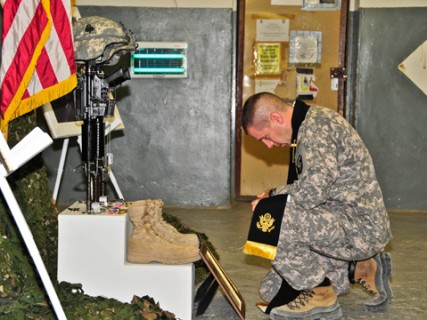
Army Chaplain Capt. Joseph Odell mourns a fallen soldier in Afghanistan.
As a student at the U.S. Naval Academy in Annapolis, Md., Aaron Kleinman was the “Jew who did Jewish stuff.” Although he served two years as president of the academy's Jewish Midshipmen Club, becoming a rabbi had never really entered his mind. If he hadn't experienced deployments on two carrier ships that didn't have onboard Jewish chaplains, it might have remained that way.
Kleinman, 38, had grown up in a Conservative Jewish home. When he was stationed in St. Augustine, Fla., he and his wife gradually grew comfortable with an Orthodox lifestyle.
Kleinman, who already had begun studies “to fill in some the gaps in my Jewish knowledge,” left active duty in 2005 for the reserves. But the rabbi shortage was growing more acute. Kleinman saw the number of Navy rabbis drop from 15 in 1995 to seven a decade later.
“Sometime around then, I realized that I needed to become a chaplain,” said the rabbi, a lieutenant stationed aboard the USS Harry S. Truman in his hometown of Norfolk, Va. “As someone who had proven compatibility with the military lifestyle, this was something I should do.”
Thirty-five rabbis are on active military duty, 13 of them in the Navy.
Kleinman was ordained in 2007 through a military chaplaincy program offered by the Yeshiva Pirchei Shoshanim in Lakewood, N.J. “If I felt there were enough Jewish chaplains to go around,” he said, “I don't know if the interest to be a rabbi would have come to me.”
As a boy, Brian Wood wanted to be a priest — according to his parents, that is. He, however, doesn't remember that. Instead, he went straight from high school into the Air Force.
Several Catholic chaplains told him that he should become a priest, he said, citing his “strength of faith and they thought I had a glow to me, that I looked like a priest.”
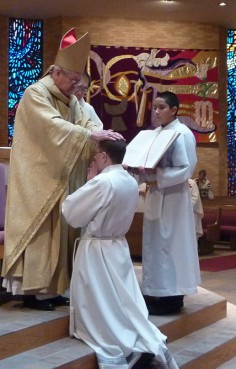
Bishop Plácido Rodríguez of Lubbock, Texas, ordains Air Force Lt. Brian Patrick Wood as a Roman Catholic deacon. Wood is hoping to serve as an Air Force chaplain after three years of pastoral work in the Lubbock diocese.
Today, he is a seminarian at the Sacred Heart Major Seminary in Detroit, supported by both his home diocese in Lubbock, Texas, and the Archdiocese for the Military Services. After his expected graduation in June, Wood, 36, is scheduled to do three years of pastoral work in Lubbock, where he hopes to remain in the Air Force reserves, before returning to active duty.
Some 200 priests serve in the military, down from 400 just a decade ago.
“I have a strong passion for the military and for my faith,” Wood said. “What better way to put those two together than become a military chaplain.”
Plus, he believes, having been in the military will give him a leg up over other new chaplains.
“There's a large learning curve” to military life, he said. “Having been in the military, it's an easier transition and I'll be able to relate more easily, at least initially.”