


French Mormons find a less hospitable 'Mormon moment'
CHESNAY, France (RNS) With 36,000 members and a history stretching back to the1850s, France's Mormon community is among the biggest and oldest in Europe. But while Mormons in the U.S. bask in the so-called "Mormon moment," French Mormons are facing stiff opposition in their bid to build the country's first Mormon temple. By Elizabeth Bryant.
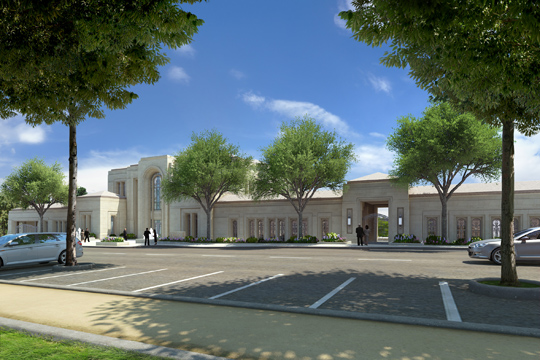


CHESNAY, FRANCE (RNS) Past clusters of houses and frozen fields in this Paris suburb, the Palace of Versailles sparkles in the evening sun. But Mayor Philippe Brillault has his eyes set on a different landmark: an abandoned, asbestos-choked power plant.
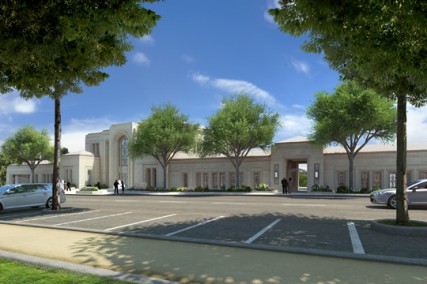
The proposed temple of the Church of Jesus Christ of Latter-day Saints outside Paris has generated from opposition from some locals, who see Mormons as a secretive sect.
It's the spot where the Church of Jesus Christ of Latter-day Saints would like to build France's first Mormon temple.
“We weren't overjoyed, because Mormons have an image that's pretty much negative,” the mayor said. “But for what can we reproach these people? Not polygamy. Proselytizing was the biggest concern.”
With 36,000 members and a history stretching back to the 1850s, France's Mormon community is among the biggest and oldest in Europe. But while Mormons in the U.S. are asserting their clout with Mitt Romney's presidential bid, their faith mostly draws blank stares here.
That is changing, partly due to French media coverage of the U.S. elections and Romney's stint as a young Mormon missionary in France during the 1960s. And partly because of concerns about the temple project.
“It's a form of opposition that's sometimes manifested because people don't know us,” said LDS spokesman Christian Euvrard. “But when people get the real information, of course, they will see that most of those false ideas will fall by themselves.”
Mormons in France currently attend services at one of more than 100 meetinghouses around the country. But they must travel to Germany or Britain for special services like weddings and proxy baptisms that can only take place in temples. Across Europe, the church counts nearly half a million members.
“Going to temple is a wonderful experience — it's a time to contemplate things going on in our lives, things we've learned in the gospel and scriptures,” said 40-year-old Tucson, Ariz., native Darla Pape, one of a handful of American ex-pats who attend Mormon church in the neighboring town of Versailles.
“Church members in France would see many blessings to have a temple close by.”
The mayor ultimately granted the building permit after finding no grounds to refuse it. Mormon officials hope to complete the temple — along with gardens and a guesthouse — within the next few years.
But opposition is growing. An online petition has already gathered 6,000 signatories against the project, although the mayor says most are not local residents.
“Would I have preferred something else?” asks Brillault. “Sure. But because I'm a Catholic and they're Mormons is no reason to say no.”
Political opponents disagree. They claim the mayor rammed the project through with little debate, and that the site is better suited for other purposes, like public housing.
“This is a way for the Mormons to plant themselves on national territory for the long haul,” said municipal councilor Berengere Brunel. “There are examples of sectarian currents in this movement. This goes way beyond Chesnay.”
Marie Drilhon, local chapter head of UNADFI, a nongovernmental group that fights religious extremism, is also skeptical about the Mormons and their project.
“It's a demanding church for the faithful,” she said, describing some cases of members who have left the church who were pressured to return. “People who are more fragile don't do well in this church.”
But the controversy also illustrates a larger wariness of non-mainstream religions in France, where a government watchdog group monitors cults. While the LDS church is recognized here, others — like the Church of Scientology, which lost a recent appeals ruling on fraud charges — are considered sects.
“The United States was built in large part on the belief in religious freedom,” said political analyst Nicole Bacharan. “The French Republic was built against the church, and the value of separation of state and church is extremely strong. Whenever there seems to be some infringement, (the) French get all fired up.”
“Mormon temples tend to be really big,” she added. “And only Mormons can attend ceremonies in temples — so that can also create suspicion.”
On the streets of Chesnay, opinions are divided.
“I've watched television reports about the Mormons, especially in America,” said resident Veronique Lindet. “I try to be fairly open, but I have to admit I think it's a form of sect.”
But another woman, who only gave her first name, Michelle, only laughed.
“I've visited Salt Lake City three times so I know the Mormon temple and everything about it,” she said. “It doesn't mean I'm going to convert.”
Euvrard, the local church spokesman, said that while only the faithful will be able to visit the temple, the surrounding gardens will be open to the public.
“Some fear Chesnay will become a new Salt Lake City, that they will see Mormons everywhere,” he said. “These are just fantasies. The more people get to know us, the more they will get the right ideas.”