


Americans intrigued but wary still of Mormon beliefs
(RNS) Suddenly, America's abuzz about Mormonism's "gold plates and magic underwear," says Terryl Givens, a professor of religion at the University of Richmond. Mormon ways are little-known, yet many Americans are suspicious of them. Why? Cathy Lynn Grossman reports.
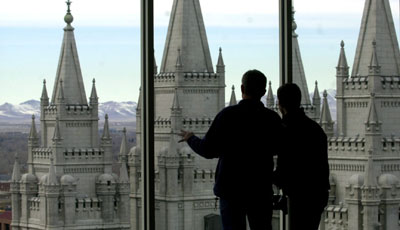


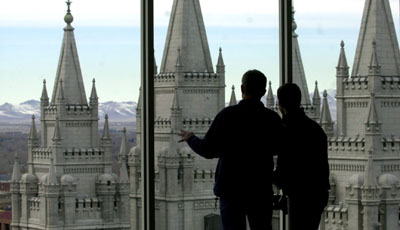
Michael Patrick and Eduardo Martins, both members of the Church of Jesus
Christ of Latter-day Saints, observe Temple Square from an observation deck in Salt Lake City,
(RNS) When Mormons call themselves “a peculiar people,” they mean it in the biblical sense — set aside by God, chosen.
But many Americans call them peculiar in Webster's way — strange, odd.
Now Mormons, followers of the Church of Jesus Christ of Latter-day Saints, are in the spotlight. One of their own, Mitt Romney, is a leading contender for the Republican presidential nomination.
Suddenly, America's abuzz about “gold plates and magic underwear,” says Terryl Givens, a professor of religion at the University of Richmond in Virginia and a Mormon himself.
Mormon ways are little-known, yet many Americans are suspicious of them. That could be because:
— Mormons are unfamiliar to many. There are 6 million, adults and children, accounting for fewer than 2 percent of the U.S. population, and 76 percent live in a handful of Western states.
— Outspoken evangelical pastors call Mormonism a non-Christian “cult,” Mormons disagree, saying they just center their faith on a different understanding of God, Christ, Scripture and salvation than Catholics or Protestants. Christian private schools and home-schooling associations specify that the Bible is the only Scripture, thereby excluding Mormons, who add three more holy books.
— Unlike Judaism, Mormonism is not a faith commonly studied in comparative religion classes. When Mormons show up in history books, it's generally limited to a saga of persecution (they were driven from the Midwest to Utah in the 19th century) and legal conflicts over polygamy. The church banned polygamy in 1890, but polygamist splinter groups, such as those depicted in “Big Love” and “Sister Wives” often see more media airtime than mainstream Mormons.
Joseph Smith founded the LDS church, according to church teachings, after discovering gold plates buried in upstate New York that he believed contained the words of ancient prophets detailing Jesus' visit to the New World. When translated, it became the text of The Book of Mormon, which Mormons believe is essential to restoring the original church as Christ intended. According to one of the four books of Mormon scripture, The Pearl of Great Price, Smith later returned the golden plates to an angelic guardian.
Some adult Mormons in good standing with the church wear a simple cotton T-shirt and fitted pants that have been blessed by the church.
“Once someone actually lifted the sleeve of my shirt to peek while asking, 'Do you wear the magic underwear?' Stop! I don't check your underpants!” recalls Erin Gillie, 26, who moved to Washington, D.C., from Alabama last week. She wears the undergarments, she says, “as a reminder of who I am: a child of God who should live by certain standards.”
“A lot of people have preconceived ideas about Mormons, and there's not much I can do to change their minds if their pastor is telling them Mormons are evil,” she says. “People will ask, 'How many moms do you have?' I've had dates who never called again once they learned I was Mormon. I figure it's their loss.”
Mormons cherish their “peculiar” distinctiveness, says Michael Otterson, chief spokesman for the LDS church.
“We value and recognize and respect the values of other religions, but we very much appreciate our own. If you are a Latter-day Saint, a member of the fourth-largest (denomination) in the country, you shouldn't have to go hat in hand for acceptance while acceptance of other minorities — Jews or Muslims or Presbyterians — is taken at face value,” he says.
Of course, Otterson notes, “You may not even know that the person who cuts your hair or does your taxes is a Mormon because we're totally integrated in the American mainstream already.”
If you're not a Mormon you're about as likely to know one as you are to know someone Jewish, and about three times more likely to meet a Mormon than a Buddhist or a Muslim.
A survey of Mormons released last week by the Pew Forum on Religion & Public Life delineated Mormons traditionalist values — high on family and education. Most (67 percent) of adult Mormons are married, compared with 52 percent of the nation. College-educated Mormons also have the highest level of commitment to religious orthodoxy: 84 percent say they follow the teachings “wholeheartedly.”
Other Christians, not so much.
On Pew Forum's 2010 U.S. Religious Knowledge Survey, which asked 32 questions on the Bible, major religious figures and core beliefs and practices, the average score was 16 correct. Just 19 percent of Protestants knew the basic tenet that salvation is through faith alone, not actions as well. Who scored best? Atheists, Jews and Mormons.
Mormons' strong communities make them a potent organized force, whether for joining in relief programs, campaigning for a moral cause or proselytizing by those ubiquitous young missionaries knocking on doors from Peoria to Peru.
Advocates of same-sex marriage still burn over the millions in donations and savvy campaigning by Mormons backing Proposition 8, which overturned legal gay marriage in California in 2008.
The Los Angeles Gay & Lesbian Center turned its outrage into a moneymaker and rallying point. The center raised $70,000 in contributions. Jim Key, spokesman for the center, says, “For each donation, we sent a postcard to LDS President Thomas Monson saying a gift had been made in his name to invalidate Prop 8.”
It's Mormons' religious outreach that worries Warren Cole Smith, an evangelical blogger and associate publisher of World, a Christian news magazine. He fears a Romney presidency would give credence and publicity to a “false faith.”
One proof of falsehood, to Smith, is that Mormons believe the Bible didn't close the book on God's revelations. They believe present-day prophets, including the president of the church, can proclaim new teachings from God.
Smith cites two examples: The LDS church banned polygamy in 1890 (perhaps, say historians, prompted by the threats from the U.S. government and by the Mormons' wish to see Utah become a state).
And in 1978, then-LDS president and prophet Spencer Kimball overturned the church's ban on ordaining black men to the priesthood.
Smith's oft-quoted line that makes evangelicals jittery is that Mormons “may believe one thing today, and something else tomorrow.”
Still, Smith ruefully admits: “The vast majority of Americans won't care about these theological implications. Indeed, Americans are generally tone-deaf to theological nuances.”
(Cathy Lynn Grossman writes for USA Today.)